

Search behaviour is changing rapidly as AI-powered tools become more integrated into how people find information online. Instead of browsing lists of links, users increasingly ask direct questions and receive summarized answers generated by artificial intelligence. These answers are built from information gathered across many websites.
For businesses, this shift means that traditional search optimization alone may not be enough. While ranking in search engines remains important, companies also need to ensure their content can be understood and used by AI systems that generate answers through effective AI search optimization.
Optimizing a website for AI-generated search results involves more than simply adding keywords. It requires structuring information clearly, publishing useful knowledge, and making it easy for both people and machines to interpret your content.
The goal is to help AI systems recognize your website as a reliable source when explaining topics related to your industry.
Focus on Answering Real Questions
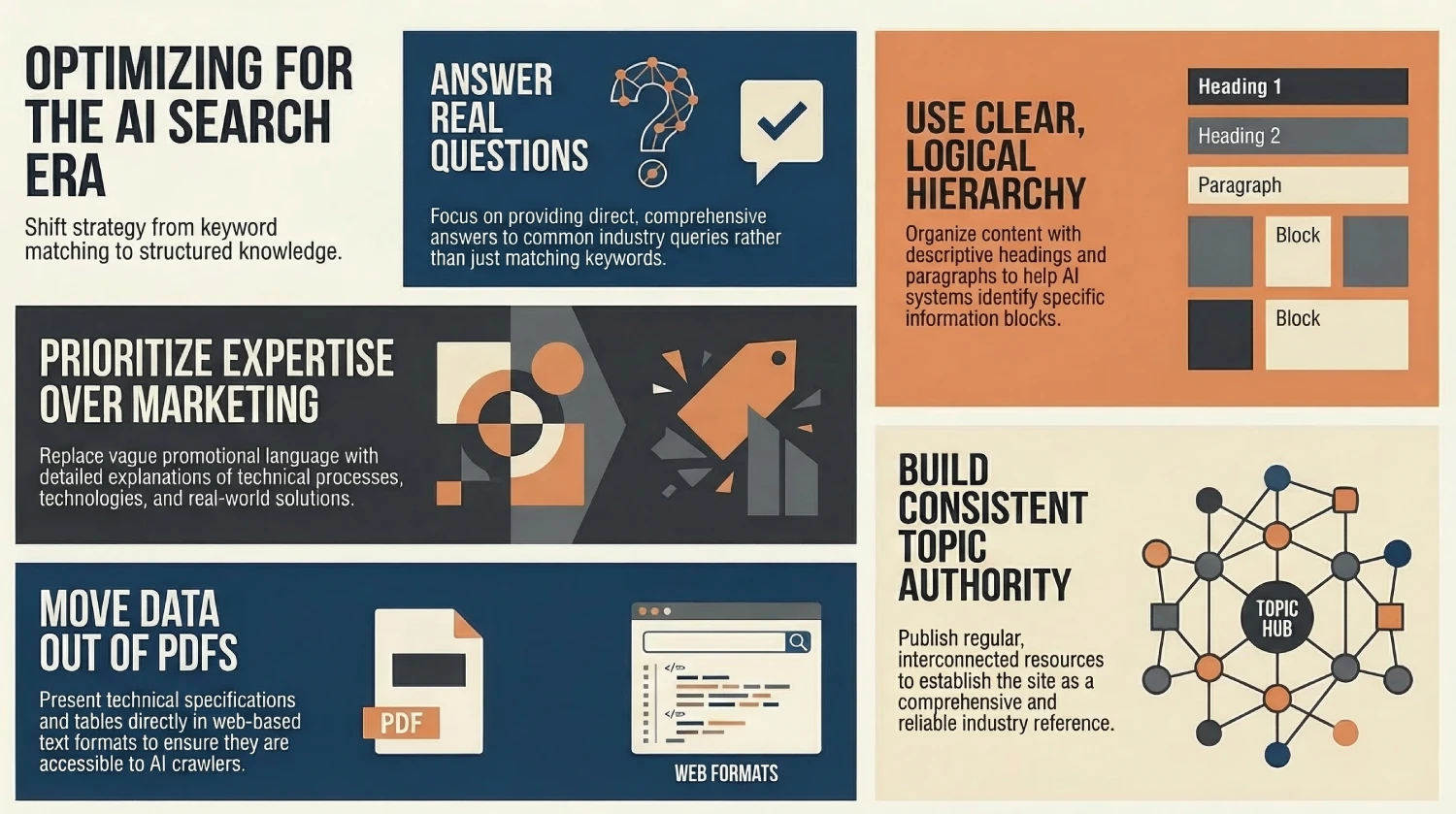
AI-powered search tools are designed to respond to questions rather than just match keywords. This means that content optimized for AI visibility should focus on answering real questions people ask.
Think about the types of questions potential customers or industry professionals might ask when researching your products or services.
For example, a company involved in manufacturing might create content addressing questions such as:
- How does CNC machining work?
- What materials are best for high-temperature industrial components?
- How do automated manufacturing systems improve production efficiency?
By answering these questions directly, your website provides information that AI systems can use when generating responses for similar queries.
Create Clear, Structured Content
Structure plays a major role in helping AI systems understand a webpage. Content that is organized into clear sections with descriptive headings is easier for machines to interpret.
Each page should focus on a specific topic and break information into logical sections. Headings help define the subject of each section, while paragraphs explain the details.
This structure makes it easier for AI systems to identify which parts of the page answer particular questions.
For example, a page about industrial cooling systems might include sections covering operating principles, system components, maintenance considerations, and common applications.
This type of organization improves both readability for humans and interpretability for AI systems.
Provide Detailed Explanations of Your Expertise
AI search systems tend to favour content that provides clear and detailed explanations rather than simple marketing language.
Many business websites focus primarily on promotional messaging. While this may communicate what a company sells, it often lacks the educational value that AI systems need when generating answers.
Instead of simply describing products or services, companies should explain how their technologies work, what problems they solve, and how they are used in real-world situations.
For example, rather than stating that a company offers “advanced industrial filtration systems,” a more helpful page might explain how different filtration technologies remove contaminants and how engineers choose the appropriate system for specific environments.
These types of explanations are more likely to be used when AI systems generate responses.
Use Simple and Clear Language
AI systems analyze language patterns when interpreting information. Content that uses clear, straightforward language is easier to understand and summarize.
This does not mean oversimplifying technical information. Instead, it means presenting ideas in a logical and readable way.
Complex sentences, excessive jargon, or vague descriptions can make it harder for AI systems to determine what the content actually explains.
Clear definitions, concise explanations, and logical progression between ideas help both readers and machines follow the information.
Organize Technical Information in Accessible Formats
Technical industries often rely on documents such as PDFs, catalogues, and specification sheets. While these resources are useful for engineers and customers, they are not always easy for AI systems to analyze.
Whenever possible, important information should also appear in web-based formats.
For example, product specifications can be presented in tables directly on the webpage rather than only inside downloadable documents. Technical explanations can appear in structured text sections rather than being buried inside brochures.
When information is accessible in web content, AI systems can interpret and reference it more easily.
Build Topic Authority Through Consistent Content
AI systems evaluate websites not only based on individual pages but also on their overall knowledge within a topic area.
A website that publishes multiple articles, guides, or resources related to a specific field gradually builds authority in that subject.
For example, a company specializing in industrial automation might publish content explaining robotics integration, control systems, safety protocols, and manufacturing optimization.
Each piece of content reinforces the company’s expertise and increases the likelihood that AI systems will recognize the site as a reliable source.
Consistency is key. Publishing useful information regularly strengthens a website’s knowledge presence over time.
Use Structured Data Where Possible
Structured data helps machines understand the meaning of information on a webpage. By labelling specific elements such as products, organizations, and technical specifications, websites provide clear signals about the type of information they contain.
Structured data does not replace well-written content, but it can help search systems interpret important details.
For example, structured data can clarify:
- product attributes and specifications
- company information
- locations and services
- technical documentation
These signals help search systems organize information more accurately.
Ensure Your Website Is Technically Accessible
Even the best content cannot contribute to AI-generated answers if search systems cannot access it.
Technical accessibility includes factors such as page speed, mobile compatibility, and proper indexing.
Websites should ensure that important pages are not blocked by technical restrictions and that navigation structures allow search crawlers to reach all relevant content.
Clear internal linking also helps machines understand how different pages relate to one another.
A technically sound website provides a solid foundation for both traditional search and AI-driven discovery.
Earn Recognition from Industry Sources
AI systems often rely on signals of trust when evaluating information sources. When other reputable websites reference or link to your content, it reinforces the credibility of your information.
Industry publications, research organizations, and professional associations can all contribute to this recognition.
When your company’s expertise is cited in these contexts, it strengthens the perception that your website provides reliable knowledge.
Over time, this type of recognition can increase the likelihood that AI systems will reference your content.
Update and Expand Content Regularly
Industries evolve, technologies change, and best practices improve over time. Websites that regularly update their content remain more relevant and useful.
AI systems tend to favour sources that appear active and current. Updating existing articles with new insights, expanding explanations, or adding additional technical details can improve the value of the content.
Even small improvements, such as clarifying explanations or adding new sections, can make a page more useful to both readers and AI systems.
Think of Your Website as a Knowledge Resource
One of the most effective ways to optimize for AI search is to treat your website as a knowledge resource rather than just a marketing platform.
Companies possess valuable expertise that is often not widely documented online. Sharing this expertise through clear explanations helps fill knowledge gaps within the industry.
For example, a manufacturer might explain common engineering challenges, testing methods, or design considerations related to its products.
When companies share this type of information openly, their websites become useful reference points for people learning about the industry.
AI systems often rely on these types of resources when generating answers.
Understand That Results Take Time
Optimizing for AI-generated search results is a long-term process. Just as traditional SEO improvements take time to develop, AI visibility grows gradually as websites publish useful knowledge and build authority.
Companies should focus on steady improvement rather than expecting immediate results.
Over time, as more educational content is published and recognized by search systems, the likelihood of appearing in AI-generated answers increases.
Conclusion
Optimizing a website for AI-generated search results requires a shift in perspective. Instead of focusing only on keywords and rankings, businesses must focus on providing clear, structured knowledge that helps answer real questions.
Content that explains technologies, processes, and industry practices is particularly valuable in AI search environments. When this information is organized clearly and supported by strong technical foundations, it becomes easier for AI systems to interpret and reference.
Companies that treat their websites as educational resources rather than purely promotional platforms will be better positioned for the future of search.
As AI-powered tools continue to shape how people discover information, the businesses that succeed will be those that contribute meaningful knowledge to the digital ecosystem.