

Many businesses that have invested years in search engine optimization are now asking an important question: Does ranking well in Google still matter when it comes to AI-powered search?
AI search tools are changing how information is delivered online. Instead of presenting a list of links, many platforms now generate direct answers by combining information from multiple sources. Systems such as AI chat assistants and AI-enhanced search engines summarize knowledge and present it in a conversational format.
This shift can make it seem as if traditional rankings no longer matter. However, the reality is more nuanced. Ranking in Google does not automatically guarantee that your company will appear in AI-generated answers, but it still plays an important role in visibility.
Understanding how these systems interact can help businesses see how their existing SEO efforts contribute to AI search visibility.
Traditional Search Rankings Still Influence AI Systems
Google search rankings are built on many signals, including content quality, website authority, backlinks, technical structure, and user engagement. Websites that perform well in traditional search usually demonstrate strong credibility and relevance.
AI systems often rely on similar signals when determining which sources to trust. Even when an AI tool generates a summarized answer, it still needs to gather reliable information from across the web.
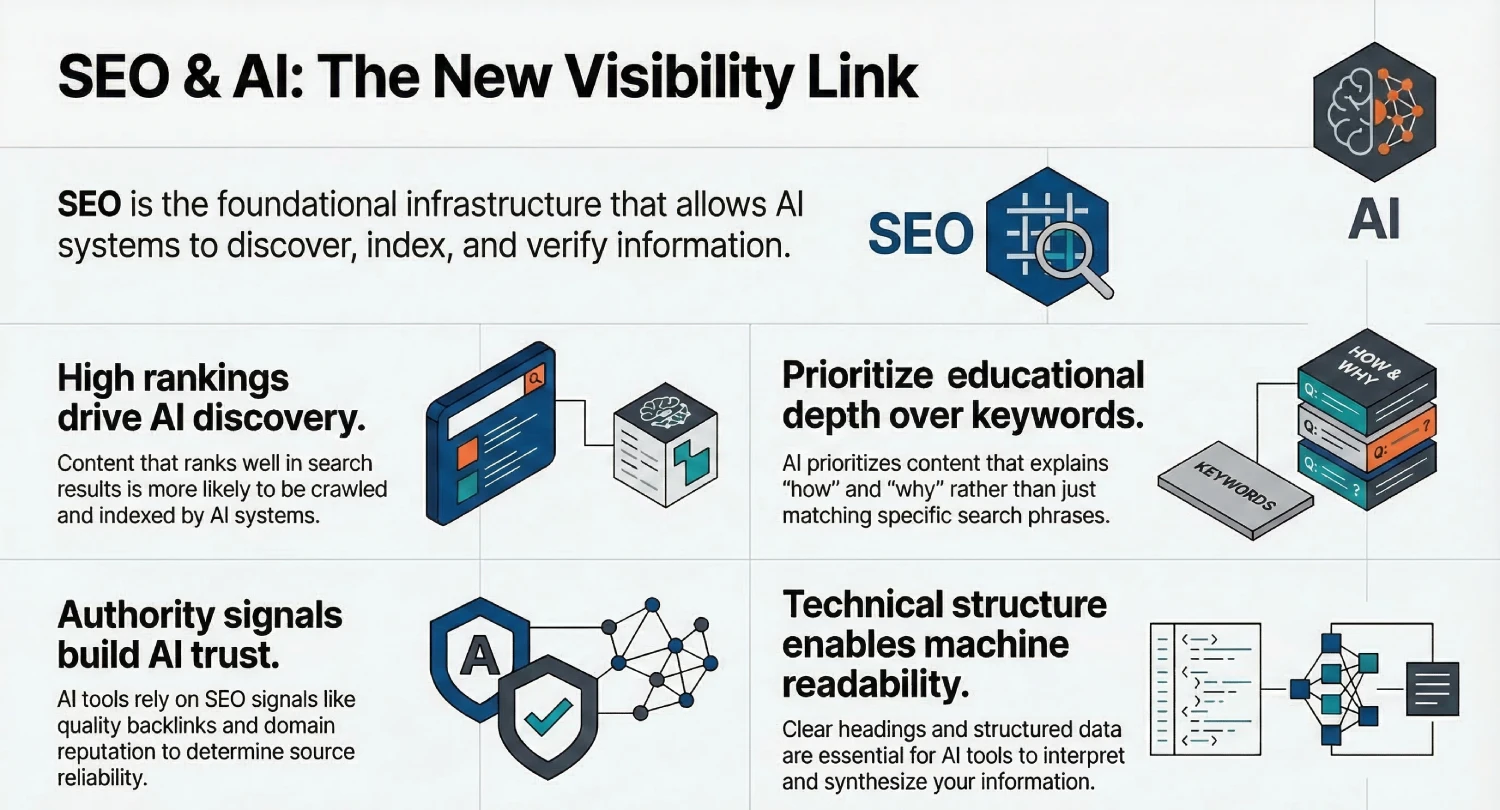
Websites that rank well in search results are more likely to be discovered, indexed, and analyzed by these systems. Because of this, traditional search visibility often increases the chances that a website’s content will be used in AI-generated responses.
However, this relationship is indirect rather than automatic.
High Rankings Do Not Guarantee AI Citations
Although ranking well in Google improves visibility, it does not guarantee that your content will appear in AI-generated answers.
Traditional search results are based on ranking pages for specific keywords. AI systems operate differently. They attempt to answer questions by synthesizing information from multiple sources.
This means a page that ranks highly for a keyword may not necessarily contain the type of explanation that AI systems need to generate a clear answer.
For example, a product page that ranks well for “industrial pumps” might contain marketing descriptions and specifications, but it may not explain how industrial pumps work or when different types should be used. If a user asks an AI system about pump types or applications, the system may instead rely on educational resources that provide detailed explanations.
In this case, strong search rankings alone would not ensure visibility in the AI response.
AI Search Focuses on Knowledge, Not Just Keywords
Traditional SEO strategies often focus on optimizing pages for specific keywords. Businesses may create multiple pages targeting variations of search phrases in order to rank for those queries.
AI systems interpret language more broadly. They analyze the meaning behind questions rather than focusing strictly on exact keyword matches.
Because of this, AI search tends to prioritize content that explains concepts, processes, and relationships between technologies.
A website that ranks well for a keyword may still be overlooked by AI systems if the content does not provide the depth of explanation required to answer user questions.
This is why businesses increasingly combine traditional SEO with educational content and AI search optimization strategies that explain how their products or services actually work.
Ranking Helps with Discovery and Indexing
One important way that Google rankings contribute to AI visibility is through discovery.
Search engines continuously crawl and index websites across the internet. Pages that rank well in search results tend to receive more traffic, more links, and more attention from indexing systems.
This increased visibility makes it more likely that AI systems will encounter and analyze the content.
In contrast, websites that are difficult to find or rarely indexed may never become part of the information sources used by AI tools.
In this sense, traditional SEO still plays a foundational role in helping content reach the systems that power AI search.
Authority Signals Often Overlap
Another connection between traditional rankings and AI search visibility involves authority signals.
Websites that rank highly in search results often have strong authority indicators, such as:
- high-quality backlinks
- consistent industry citations
- trusted domain reputation
- well-structured content
- positive user engagement
AI systems frequently rely on similar indicators when evaluating which sources to trust. If multiple reputable websites reference the same information, AI tools are more likely to consider it reliable.
This means that companies with strong search authority may already have an advantage when it comes to AI visibility.
Educational Content Improves Both SEO and AI Visibility
One area where traditional SEO and AI search align closely is educational content.
Pages that clearly explain topics often perform well in traditional search results because they match informational queries. At the same time, these pages provide exactly the type of knowledge that AI systems need when generating answers.
For example, a detailed guide explaining how industrial filtration systems work may rank well in Google when users search for filtration technologies. The same guide may also be used by AI systems when answering broader questions about filtration processes.
Content that teaches rather than simply sells tends to perform well in both environments.
Technical SEO Still Matters
The technical structure of a website also plays a role in both traditional search rankings and AI visibility.
Elements such as clear headings, organized page structure, internal linking, and structured data help search systems interpret content more easily.
When pages are well organized, machines can identify the main topics, subtopics, and relationships between different pieces of information.
This clarity benefits both traditional search algorithms and AI systems that analyze content when generating responses.
Websites with confusing navigation, poorly structured pages, or inaccessible content may struggle to perform well in either environment.
AI Systems Often Combine Multiple Sources
Another important difference between traditional rankings and AI answers is how information is combined.
Traditional search results typically display individual pages ranked by relevance. Users choose which links to visit.
AI systems often combine information from several sources to produce a single explanation.
This means that even if a website ranks highly, it may only contribute a portion of the knowledge used in the final answer.
Conversely, a smaller website that does not rank at the very top may still contribute useful information if its content clearly explains a specific concept.
This blended approach makes AI visibility more dependent on the quality of explanations than on ranking position alone.
Industry Publications Often Appear Frequently in AI Answers
In many industries, AI-generated responses frequently reference technical publications, research articles, and educational resources.
These sources often provide comprehensive explanations that cover entire topics rather than focusing on a specific company or product.
Businesses that want to increase AI visibility sometimes publish similar educational content on their own websites. By explaining technologies, processes, and industry practices, companies contribute knowledge that AI systems can use when generating answers.
This approach helps balance traditional marketing content with informative resources.
Ranking Helps Build Long-Term Trust
Another reason traditional rankings still matter is that they reflect long-term trust signals.
Websites that maintain strong search visibility usually have a history of producing useful content and earning recognition within their industries.
AI systems tend to rely on sources that appear stable and trustworthy over time.
Because of this, businesses that have invested in strong SEO foundations often find it easier to extend their visibility into AI-powered search environments.
Businesses Should Not Abandon SEO
Some companies worry that AI search will make traditional SEO services obsolete.
Search engines still serve as the primary method for discovering and indexing information across the web. AI systems rely heavily on these underlying search infrastructures.
If a website is poorly optimized for search, it becomes much harder for AI systems to find and interpret its content.
Rather than replacing SEO, AI search builds on the same digital ecosystem.
The Best Strategy Combines Both Approaches
Businesses that want to maximize visibility should focus on strategies that support both traditional search rankings and AI-generated answers.
This includes:
- maintaining strong technical SEO
- publishing educational content about industry topics
- providing clear explanations of products and technologies
- building authority through industry citations and partnerships
- organizing information in ways that machines can easily interpret
These practices strengthen a website’s overall presence in the digital knowledge ecosystem.
When content is both searchable and informative, it becomes more likely to influence AI-generated responses.
Conclusion
Ranking well in Google does help with AI search visibility, but the relationship is indirect. High rankings increase the likelihood that your content will be discovered, indexed, and trusted by the systems that power AI-generated answers.
However, ranking alone does not guarantee inclusion in AI responses. AI systems focus heavily on the quality and clarity of information when generating explanations.
Businesses that combine strong SEO foundations with educational, knowledge-focused content are more likely to appear in both traditional search results and AI-generated answers.
As search continues to evolve, the most successful websites will be those that serve as reliable sources of information for both human readers and the AI systems that help people navigate the growing complexity of the internet.