


Nothing hits harder than waking up, checking your rankings, and seeing a sudden drop. Maybe a few keywords slipped. Maybe your map position fell. Maybe an important service page dropped off page one completely. It feels like someone flipped a switch while you were asleep.
The good news: a sudden drop does not always mean something is wrong. Google updates constantly. Rankings shift. Search traffic moves. Competitors make changes. And sometimes your visibility dips before jumping even higher a few days later.
But when the drop is real and stays there is always a cause. And there is always a clear path to recovery. From our experience, the worst thing you can do is panic. The best thing you can do is follow a structured process that identifies the problem fast and corrects the signals Google is reacting to.
This guide explains exactly what to do when rankings fall and outlines how we handle these situations at enOptimize. The examples are natural and grounded in real scenarios, like a company posting new project photos from a Toronto job or updating capability details after finishing a custom aluminum run in Mississauga. These are the types of clues that help us evaluate ranking shifts accurately.
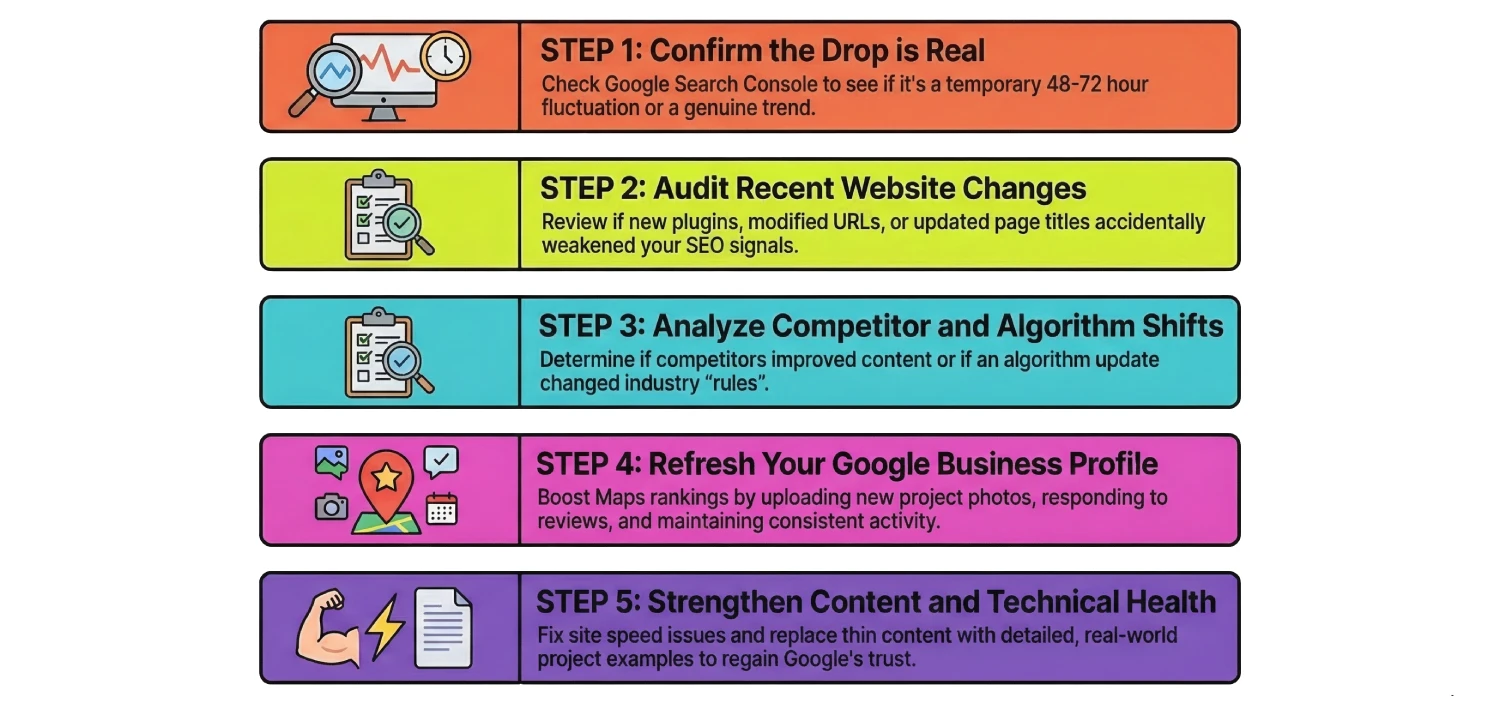
1. First, confirm the drop is real, not temporary
Google rankings fluctuate every single day. Many businesses mistake normal movement for a problem. Before reacting, we always confirm whether the drop is:
- a daily fluctuation
- a temporary test by Google
- a new competitor entering the mix
- seasonal variation
- an algorithm update
We check your Google Search Console data, Google Business Profile insights, and traffic trends to see whether the change is real or just noise. Often, it’s noise and the ranking returns to normal in 48 to 72 hours.
2. Look for sudden changes on your website
Next, we check whether something changed on your website that may have triggered the drop. Even small adjustments can impact ranking:
- a page title changed
- a URL was updated
- a service page was modified incorrectly
- a plugin broke something behind the scenes
- a technical update slowed your site down
At enOptimize, the first thing we do is review the website’s recent activity to see whether anything changed without being noticed.
3. Check whether a competitor made a major improvement
Sometimes your ranking doesn’t drop because you did something wrong, but someone else simply did something better. Maybe a competitor added new examples. Maybe they improved their service pages. Maybe they upgraded their Google Business Profile or improved their speed.
We look for:
- new content on competitor sites
- fresh local examples
- new reviews
- changes in their map listings
- improved page clarity
- faster technical performance
For instance, if a competitor just posted a large, detailed project completed in Toronto, Google may temporarily test their page above yours. This doesn’t mean your visibility is gone, it simply signals an opportunity to strengthen your own content.
4. Look at your Google Business Profile activity
Google Maps rankings can drop suddenly when activity slows down. A lack of recent reviews, no new photos, or low engagement can all cause temporary dips.
We review:
- your latest reviews (and whether they were responded to)
- recent photo uploads
- changes to categories
- duplicate profiles or issues
- status warnings from Google
A ranking drop on Maps almost always connects to a change in activity. Even simple actions, like posting a recent project photo or encouraging a customer to leave a review, often help stabilize the listing again.
5. Evaluate the quality of recent content updates
When a ranking drop occurs, we check whether recent updates strengthened your pages or accidentally weakened them. Content that becomes too vague, generic, or thin often loses ranking power.
For example:
- If a client shortens a detailed capability page, Google may see it as less informative.
- If an example describing a Toronto job removes key details, Google may lose city relevance.
Sometimes, content is improved visually but loses strategic value. We make sure both clarity and ranking signals stay intact during updates.
6. Check for missing or weakened examples
Examples play a massive role in relevance. When rankings drop, we check whether any example pages were removed, renamed, or rewritten. Even removing a single strong example, like a detailed Toronto installation, can weaken location relevance.
Real-world proof is one of the strongest modern ranking signals. Google reacts quickly when it disappears.
7. Review recent backlinks and mentions
Backlinks rarely cause sudden ranking drops unless something unusual happens, like:
- a spam backlink attack
- an important backlink was removed
- a partner website went offline
If a supplier removes their partner page, or a directory containing your listing shuts down, you may lose authority points. We check all recent changes to see if authority loss played a role.
8. Check technical performance
A sudden slowdown in loading speed, a broken plugin, or a hosting issue can cause Google to temporarily downgrade your pages. Technical issues can also happen quietly, without anyone noticing.
We check:
- site speed
- image compression
- mobile usability
- server response
- indexing errors
These issues can be fixed quickly, and rankings often rebound once performance is restored.
9. Look at recent Google algorithm updates
When rankings drop across multiple clients at once or across entire industries, it usually means Google adjusted its algorithm. These updates can temporarily shake results before settling.
For example, Google may start rewarding more detailed examples or punishing thin content. Updates often favour authenticity, clarity, and real-world signals, which means businesses with stronger content usually recover faster.
If an update caused the drop, we adjust the strategy to match the new rules.
10. Strengthen the areas that matter most
After identifying the cause, we move into reinforcement mode. This is where our approach makes the biggest difference. We don’t patch holes with quick fixes we strengthen your core signals so the ranking not only returns but becomes more stable than before.
This may include:
- adding new examples from recent projects (e.g., a Toronto warehouse structure or a Mississauga machining run)
- expanding important service pages
- refreshing outdated content
- improving location pages with clearer details
- updating your Google Business Profile with fresh photos
- collecting a few new reviews
These actions help Google regain confidence quickly.
11. Stay consistent after the drop
Most ranking drops aren’t permanent. But businesses that stay inactive for too long make the recovery harder. Google rewards ongoing activity, clarity, and proof. The more consistent your efforts, the faster rankings return and the more stable they become long-term.
This is why we don’t rely on tricks, spikes, or shortcuts. We rely on consistent signals that Google trusts.
The bottom line
A sudden Google ranking drop feels dramatic, but it isn’t the end of the world. It’s a signal one that can be diagnosed, understood, and corrected with a structured approach. When handled properly, rankings not only recover but often come back stronger because the process reveals weaknesses that needed attention anyway.
At enOptimize, we follow the same calm, methodical routine every time: confirm the drop, identify the cause, strengthen the right areas, and rebuild momentum with steady, meaningful improvements. It’s a practical approach that avoids panic and focuses on real solutions. And when rankings bounce back, which they almost always do, you end up with a more stable foundation than before.
Our expertise shows that recovery is rarely about quick fixes. It’s about clarity, relevance, consistency, and ongoing activity, the same things that drive long-term SEO success.