


When you work with a small SEO team like ours, you get focused attention, hands-on work, and a strategy built specifically for your business. But specializing in the same group of industries means that many of our clients operate in similar spaces, offer similar services, and sometimes even compete for similar types of projects.
This raises a fair question: How does a small agency make sure each client gets genuine value without conflict, overlap, or recycled work?
We’re open about how we handle this because transparency builds trust. Yes, we work with companies that sometimes compete. And yes, that comes with challenges. But those challenges are manageable when handled correctly. From our experience, what matters most is how the work is structured, how communication is handled, and how the strategy is built around each client’s strengths, not generic templates.
This guide explains how we balance multiple clients in the same industries, how we keep their advantages separate, how confidentiality shapes our process, and how we make sure every business gets unique, meaningful website optimization value even when their services overlap.
1. Every business has unique strengths, even if they offer similar services
On paper, two companies might look identical. Maybe they both build metal structures. Maybe they both run CNC equipment. Maybe they both handle heavy-duty installations. But in reality, no two businesses operate the same way. They differ in:
- skillsets
- project scale
- equipment capabilities
- pricing structure
- client relationships
- work quality
- response time
- geographic focus
For example, one client might be known for clean, architectural-style metal work for Toronto offices, while another may excel at machining parts with tighter tolerances for industrial clients in Mississauga. Both may operate in similar industries, but their strengths and therefore their website optimization strategies are not the same.
We focus on what makes each business stand out and build its content around that difference.
2. Confidentiality is non-negotiable
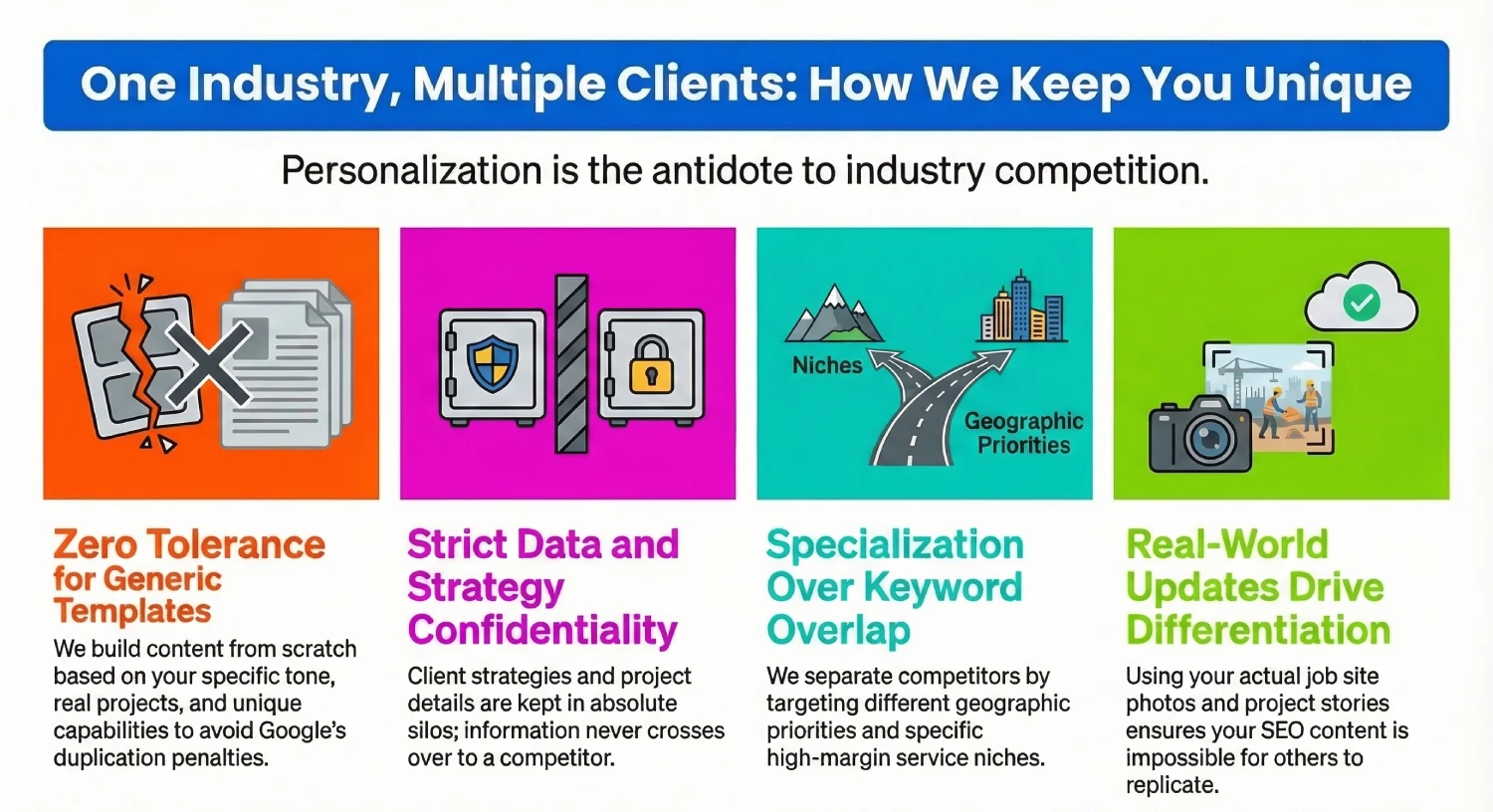
We don’t share strategies between clients. We don’t reuse content. We don’t disclose project details. We don’t compare businesses to each other. Confidentiality is a core part of how we work.
If a client shows us photos of a recent installation or machining job, that information stays within their strategy. It never crosses over to someone else. Every business deserves its own voice, its own approach, and its own competitive edge online.
We treat each client’s information with the same respect as if it were our own internal data. That’s the only way this type of work can be done properly.
3. We don’t use templates and everything is created for each client
Templates are one of the biggest traps in SEO. Agencies that rely on them produce identical pages for multiple clients, changing only a few words. Google sees this as duplication. Clients see this as lazy. And both are right.
We avoid templates completely. Instead, we build content around:
- your tone
- your real projects
- your preferred services
- your capabilities
- your location priorities
For example, one client may want more business from Toronto commercial builders, while another prefers long-term industrial partnerships in Vaughan. Even if both complete similar types of fabrication or machining work, the focus and language of the content become totally different.
4. We ask for updates because that keeps each strategy unique
The more we communicate, the easier it is to build content that reflects who you are, not the industry as a whole. This is why we encourage clients to share updates, new capabilities, projects, or photos as often as possible.
For example, if a client lets us know they recently installed a large steel structure for a warehouse near the Toronto Stockyards, that becomes unique search engine optimization material. Another client may send photos of precision aluminum work completed for a Mississauga operation. These stories naturally separate their website content without us forcing differences.
This flow of updates ensures your SEO stays personal, specific, and different from your competitors, even if you’re in the same field.
5. We identify what each business should actually highlight
When two companies offer similar services, the goal is not to promote the same things. The goal is to highlight what’s most strategic for each one. That requires conversations, not assumptions.
One client may:
- want more high-margin custom projects
- prefer fewer small jobs
- focus on certain neighbourhoods or cities
- have equipment advantages worth highlighting
- prioritize one type of work over another
By understanding what matters most to you, we separate your strategy from others in the same industry.
6. Our small size is actually an advantage, not a limitation
Big agencies use layers of staff and standardized processes, which often lead to recycled content and overlapping ideas. Being a small team means we do the opposite. We know every client personally. We know their work. We know what makes them different. And we adjust continuously.
When we write content, we’re not choosing from a library of generic paragraphs. We’re thinking about:
- your past conversations
- your actual capabilities
- your city priorities
- your project photos
- your business goals
This produces natural, real content not text that feels forced or artificially inserted.
7. We avoid keyword overlap by leaning into specialization
If two clients offer similar services, it doesn’t mean they should compete for identical keywords. Every business naturally leans toward certain strengths, job types, or city areas. We identify those and use them to shape the keyword strategy.
For example:
- One company may attract more inquiries for architectural-style metal projects in Toronto.
- Another may attract more industrial machining inquiries from Mississauga.
Even if both handle metal-related work, their search audience is not the same. By recognizing these patterns, we avoid overlap and strengthen each client’s organic reach.
8. We stay ahead by having honest conversations about goals
Clients who speak openly with us help shape their strategy in ways that avoid conflict and improve their results. We ask questions like:
- Which types of projects do you want more of?
- Which cities matter most right now?
- Which services are your strongest?
- Are you planning any upgrades or expansions?
These answers help define the direction of your website optimization, so your strategy doesn’t bleed into someone else’s path.
9. We understand the disadvantages and manage them carefully
Specializing in similar industries does come with challenges. There’s no point pretending otherwise. Clients may compete for similar search terms, similar leads, or similar project types. But specialization brings benefits too. It lets us understand the terminology, the project structure, the customer expectations, and the regional differences far better than a generalist agency.
The key is making sure that the overlap never becomes a disadvantage for you. And that’s the part we handle with care. We never recycle ideas. We never repurpose examples. We never position one client’s content in a way that mirrors another’s. Our job is to highlight your individuality, not blur it with the rest of the industry.
Our expertise shows that even companies with similar services can rank for different opportunities when the strategy is built around their unique strengths.
10. The work stays fresh because the businesses we serve are never the same
Even if two companies both build structures or run advanced machining equipment, the nature of their work evolves constantly. One may shift toward larger projects, another toward precision parts. One may expand into new cities, and another may narrow their focus to a specific niche.
Because every business grows in different directions, its search engine optimization naturally grows in different directions too. This ongoing evolution keeps everyone aligned with their own unique path.
The bottom line
Working with clients from similar industries is not a problem when handled properly. It’s an advantage because it creates expertise, familiarity, and a faster understanding of what truly matters in your field. The key is balancing that expertise with strict confidentiality, personalized strategies, and content built entirely around who you are.
We don’t copy work. We don’t recycle ideas. And we don’t treat similar businesses as if they’re interchangeable. Each client gets their own path, their own voice, and their own website optimization direction. Your strengths shape the strategy, not your industry’s overlap.
That’s how a small agency delivers big value even when clients compete in similar spaces.