

When businesses think about website design, they often focus on visual appearance, branding, and user experience.
While these elements are important for human visitors, website design also plays a significant role in how artificial intelligence systems interpret and understand your company, which is why many businesses now focus on AI search optimization when structuring their websites.
AI-powered search tools, indexing systems, and digital assistants analyze websites to determine what a company does, what services it provides, and what topics it specializes in. The structure and design of a website can either help these systems understand the information clearly or make it more difficult to interpret.
As AI-generated search results become more common, the way a website is designed can influence whether its content is recognized as a useful source of information. A well-structured site allows machines to interpret content efficiently, while a poorly organized site may hide valuable expertise behind confusing layouts.
Understanding how design affects machine interpretation can help businesses build websites that communicate effectively to both people and AI systems.
Clear Page Structure Helps AI Identify Key Topics
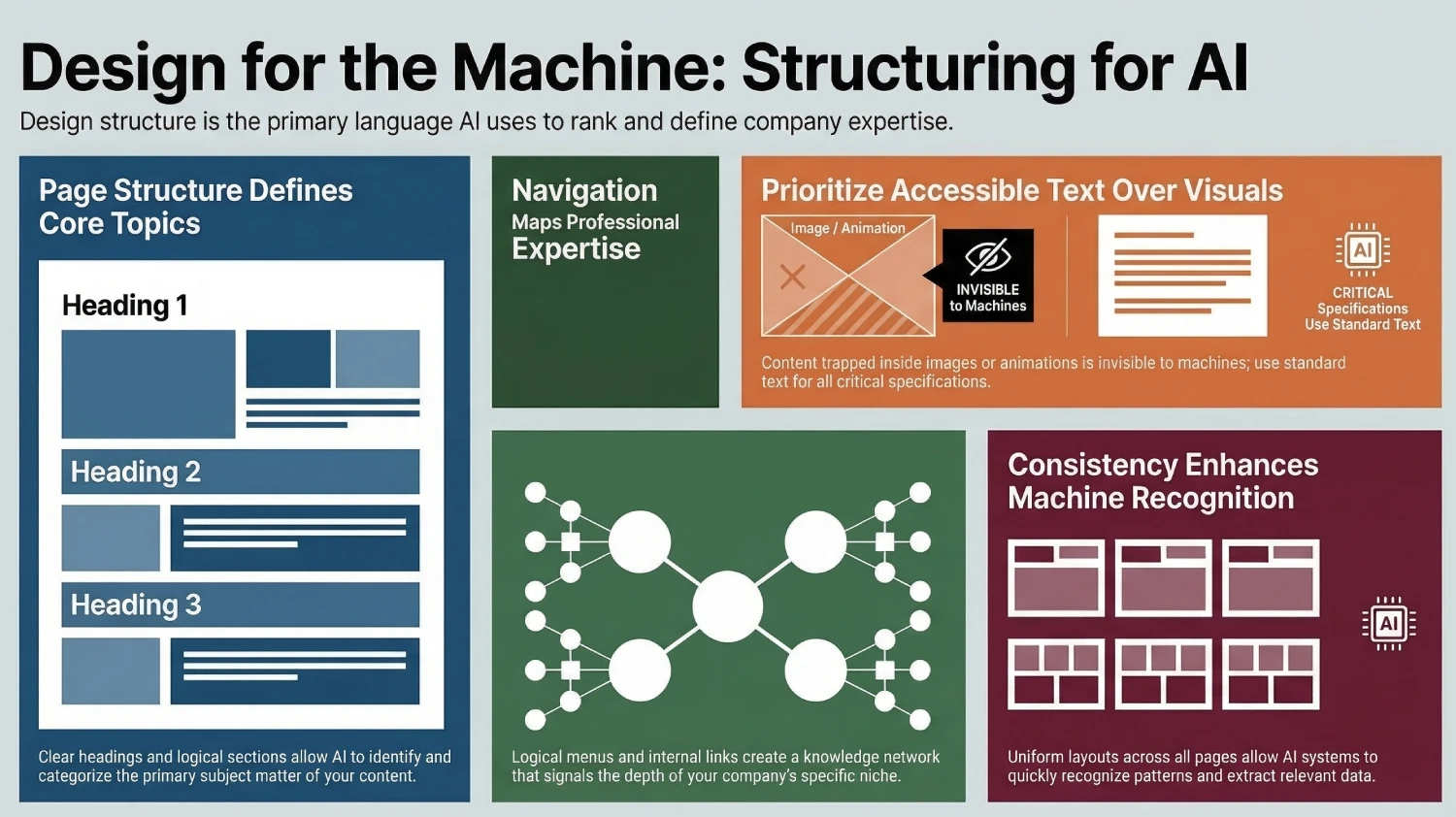
One of the most important aspects of website design for AI interpretation is page structure. AI systems analyze the layout of a page to understand how information is organized and which sections represent the main ideas.
Pages that use clear headings, logical sections, and consistent formatting make it easier for machines to identify the primary topic of the content.
For example, a page that explains an industrial service might include sections such as:
- Overview of the service
- How the process works
- Industries that use the service
- Technical specifications
- Common applications
This type of structure helps AI systems determine what information appears on the page and how different sections relate to each other.
In contrast, pages that present information in large blocks of unstructured text make it harder for machines to extract specific explanations.
Navigation Design Reveals the Company’s Expertise
The navigation structure of a website provides important clues about the areas in which a company specializes.
Menus and navigation categories show how the business organizes its services, products, and knowledge resources. AI systems can analyze these structures to understand the relationships between different topics.
For example, a manufacturing company might organize its navigation menu around categories such as machining services, materials, engineering capabilities, and quality control.
This organization signals that the company operates within a technical domain and provides specific types of services.
If the navigation structure is unclear or overly complex, AI systems may have difficulty understanding the scope of the company’s expertise.
Consistent Page Layout Improves Machine Interpretation
Consistency in page layout helps both users and AI systems interpret information more easily. When pages follow a similar structure, machines can recognize patterns across the site.
For example, product pages that consistently present information in the same order—description, specifications, applications, and technical details—allow AI systems to identify these sections quickly.
This consistency helps machines extract relevant information when generating responses to user questions.
Inconsistent layouts, where each page is structured differently, make it harder for systems to determine where key information appears.
Readable Content Layout Improves Understanding
Website design also affects how readable the content appears. AI systems analyze text in context, and readability influences how easily the information can be interpreted.
Design choices such as spacing, paragraph length, and section organization can make content easier to process.
For example, breaking long explanations into smaller paragraphs and grouping related ideas under clear headings improves readability.
This approach helps machines identify logical connections between ideas and extract meaningful information from the page.
Dense blocks of text without visual structure can make interpretation more difficult.
Accessible Text Is Easier for AI to Analyze
Some design decisions can unintentionally hide important information from AI systems. Content that appears only inside images, animations, or interactive elements may not be easily interpreted by machines.
For example, a website might display product specifications inside a graphical diagram or an image-based chart. While this design may look visually appealing, it prevents search systems from reading the text directly.
Providing the same information in standard text format ensures that AI systems can analyze and understand the content.
Design elements should enhance readability rather than replace accessible text.
Internal Linking Helps AI Understand Relationships Between Topics
Internal linking is another design feature that influences how AI systems interpret a website.
Links between related pages help machines understand how topics connect to one another. For example, a page explaining a manufacturing process might link to pages describing materials, equipment, and engineering considerations.
These connections create a network of related information that reinforces the company’s expertise.
When AI systems see that multiple pages discuss related topics and reference each other, they can better understand the broader subject area covered by the website.
This network of information helps machines recognize the depth of knowledge available.
Clear Service and Product Pages Help Define What the Company Does
AI systems attempt to interpret what a company actually does based on the content of its website. Pages that clearly define services, products, and capabilities make this interpretation easier.
For example, a service page should explain:
- what the service involves
- how the process works
- which industries use it
- what technical challenges it solves
This type of explanation allows AI systems to associate the company with specific topics and industries.
If service descriptions are vague or purely promotional, machines may struggle to determine the company’s role in the market.
Logical Site Hierarchy Helps Machines Map the Website
The hierarchy of a website refers to how pages are organized within the overall structure of the site.
A clear hierarchy allows both users and AI systems to navigate the site logically. Typically, websites organize content from broad categories to more specific pages.
For example, a technical company might structure its site like this:
- Main category: Engineering services
- Subcategory: Manufacturing processes
- Individual pages: Specific machining or fabrication services
This layered structure helps machines understand how different topics relate to each other.
Websites with confusing or flat hierarchies make it harder for systems to identify which topics are most important.
Fast and Technically Efficient Design Helps Content Be Discovered
Website performance also influences how easily AI systems can access and analyze content.
Pages that load quickly and function reliably allow search crawlers to scan the site efficiently. If pages load slowly or contain technical errors, important information may be skipped or partially indexed.
Efficient design includes optimized images, clean code, and responsive layouts that function well across devices.
These factors help ensure that all content remains accessible to both users and search systems.
Mobile-Friendly Design Expands Accessibility
Many search systems prioritize mobile-friendly websites because a large portion of internet usage occurs on mobile devices.
Designs that adapt smoothly to different screen sizes make content easier to access and interpret.
Responsive layouts ensure that headings, paragraphs, and navigation elements remain clear regardless of the device being used.
This accessibility helps search systems interpret the content consistently.
Design Should Support Knowledge Sharing
Ultimately, the goal of website design in the context of AI search is to support the clear presentation of knowledge.
Companies often possess valuable expertise about their industries, products, and technologies.
A well-designed website makes this expertise visible and understandable, which is why investing in professional website design helps businesses present their knowledge clearly online.
Design elements should help organize and highlight this information rather than hide it behind visual complexity.
When knowledge is presented clearly, both people and machines can recognize the company’s expertise.
Conclusion
Website design influences far more than visual appeal. The way information is structured, organized, and presented plays a major role in how AI systems interpret a company’s expertise and capabilities.
Clear page structure, logical navigation, consistent layouts, and accessible text help machines understand the topics covered by a website. Internal linking and organized hierarchies reinforce relationships between ideas and demonstrate depth of knowledge.
Businesses that design their websites with clarity and structure create environments where both users and AI systems can easily interpret the information.
As AI-powered search continues to shape how people discover information, website design will remain an important factor in how companies communicate their expertise to the digital world.