
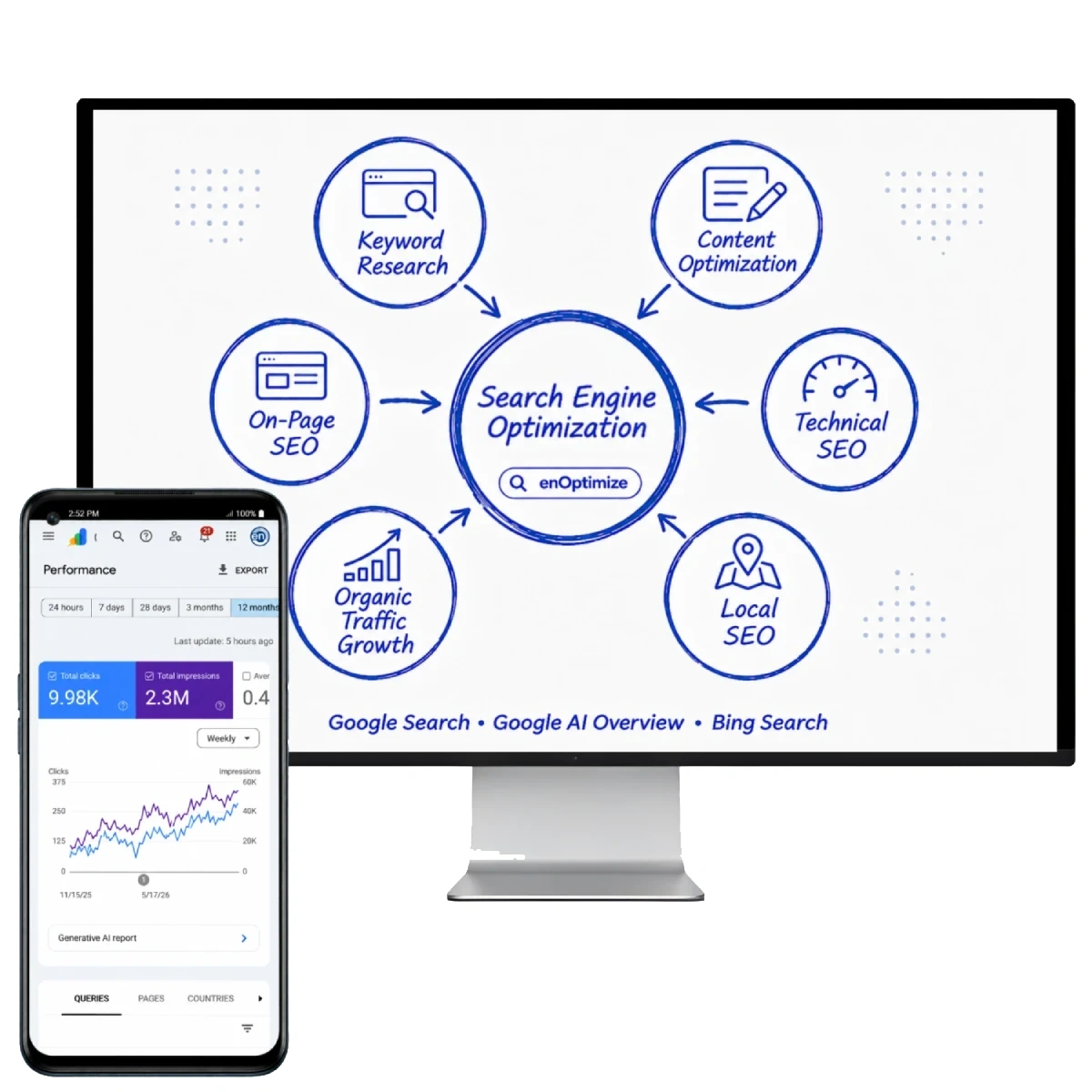

Any keyword tool will hand a manufacturer or fabricator a list of hundreds of searches, sorted by monthly volume. Deciding which of those searches would bring a buyer who can actually award work, and which would only bring visitors, is the part that decides whether SEO turns into quote requests.
When enOptimize builds an SEO strategy for a B2B company, this is the first real decision we make. Every page, every Google Business Profile service and every description we prepare for AI search tools comes back to it. Get the target searches wrong and good work on everything else still points at the wrong people.
Intent comes before volume
The first question we ask about any search is not how many people type it, but who typed it and what they were trying to do. For industrial and technical companies, most searches fall into one of three groups:
- Sourcing searches. Someone is looking for a supplier: “stainless steel fabrication Mississauga”, “5-axis CNC machining aluminum”, “commercial millwork shop drawings”. These are the searches we build strategies around.
- Research searches. Someone is learning: “what is powder coating”, “laser cutting vs plasma cutting”. A few of these are useful; most are not a priority.
- Everything else. Job seekers, students, hobbyists and people looking for a retailer. These can carry large volume and almost no buyers.
The tricky part is that the groups share the same words. “Metal fabrication” on its own brings a mix of definitions, schools, job postings and suppliers. “Custom metal fabrication for food processing equipment” is searched far less, but the person typing it almost always has a project. We look at what Google already shows for a search, because the results page tells us how Google reads the intent. If it is full of job boards and encyclopedia entries, a service page will struggle there, and it would bring the wrong visitors even if it ranked.
Matching searches to the buyer who signs
Different buyers search for the same company in completely different ways. Before choosing terms, we work out which buyer brings the profitable work, then look at how that person searches.
- Engineers search by process, material, tolerance and part type: “precision sheet metal enclosures”, “tight-tolerance titanium machining”.
- Procurement teams search by capability plus location or certification, and often compare several suppliers at once.
- Architects and interior designers search by project type and material: “hospitality millwork”, “architectural metal railings”.
- Property and facility managers search by problem or service: “loading dock door repair”, “industrial floor coating Brampton”.
For a company that mainly supplies parts to OEMs through engineering teams, we usually put process and material searches first, because that is the language on the drawings those engineers work from. If the work mostly comes from property owners and facility managers, we lead with service and problem searches tied to the areas served instead. A company with both buyer types gets both sets, kept separate, because wording that convinces an engineer rarely convinces a facility manager.
One pattern we see often: companies describe themselves in internal terms that buyers never type. A shop may call itself a “solutions provider for structural assemblies” while its buyers search for “steel weldments”. We take the buyer’s words, not the brochure’s.
Volume versus value
Search volume measures how many people type something. It says nothing about what one of them is worth. A single quote request for a production run or a commercial fit-out can be worth more than months of traffic from a popular but vague term.
So we weigh each search on four things:
- Likely project size behind the search.
- Distance to a quote request: is this person sourcing now, or still learning?
- Fit with the work the company wants. A shop trying to move away from small repair jobs should not chase repair searches, however popular they are.
- Whether a page can credibly answer it. If the company cannot show proof of a capability, ranking for it brings enquiries that end at the first call.
A search with modest volume that scores well on all four usually beats a big term that scores well on none.
Niche searches that show no volume
Keyword tools often report zero searches for very specific B2B terms, such as a process combined with a material and a city. That number is an estimate, and for narrow industrial searches it is often wrong. These searches still happen, just a few times a year, and each one can be a project.
Our rule: if a niche search describes work the company does well and wants more of, we keep it, whatever the tool says. Low reported volume is never a reason on its own to drop a term. We judge these searches by where the company ranks for them rather than by traffic, because a handful of clicks a year from the right buyer is the point. They are also usually easier to win than broad terms.
Branded and capability searches
Branded searches, meaning the company name or its product line names, come from people who already know the business. They matter: the website and Google Business Profile should own those results, and the company’s details should match everywhere so Google and AI tools describe it correctly. But branded traffic reflects reputation built elsewhere, through referrals, trade shows and existing clients. It is not where SEO growth comes from.
Capability searches are. These come from buyers who have never heard of the company and are looking for someone who can do the work. That is why we keep branded and capability results apart when we judge progress. A company can rank first for its own name and still be invisible to every new buyer in its market.
We do not target competitors’ brand names. A buyer searching for a specific competitor wants that company, and pages built to intercept them tend to look opportunistic to the very people they are meant to impress.
Searches we usually leave out
- Job and training searches such as “welder jobs Toronto” or “CNC course”, unless hiring is a real goal. When it is, careers searches get their own separate track so they do not dilute the service pages.
- How-to and DIY searches from people who plan to do the work themselves.
- Retail searches like “buy steel sheet near me” for a company that only does custom work.
- Broad national head terms where the results are dominated by directories and the intent is mixed.
- Services the company does not want or cannot deliver, even if they look easy to rank for.
Research searches are the grey area. We keep the few that sit close to a buying decision, such as comparisons between two processes, because they can support a capability page and give AI tools a clear answer to draw on. Pure definitions usually stay out.
How the chosen searches shape the rest of the work
Once the targets are agreed, we group them by the work they describe rather than treating each keyword on its own. Each group points to one page, so two pages never compete for the same buyer. The same groups set the services listed on the Google Business Profile, the way capabilities are described across the website, and the facts we keep consistent for AI search tools. AI mentions are never guaranteed, but a company that describes its work in the same terms its buyers use gives those tools a much clearer picture.
The list is not fixed. At enOptimize we revisit it as ranking data and real enquiries come in: a group that brings serious quote requests gets more depth, and a term that only brings the wrong kind of enquiry gets dropped, even if it ranks well.
What we usually find in audits
- Pages targeting only the industry name, like “manufacturing company Ontario”, and nothing a buyer would type when sourcing.
- Keyword lists picked by volume, full of job, education and definition searches.
- Strong rankings for the company name, reported as SEO success.
- No process, material or tolerance terms, which are exactly what engineers search for.
- Website copy written in internal language that buyers never use.
Choosing target searches is one part of how our SEO services work for manufacturers, fabricators and technical companies, alongside the website, Google Business Profile and AI search optimization it connects to. Our case studies show the approach in practice.