

Artificial intelligence is rapidly changing how people search for information online. Instead of only browsing through lists of websites, many users now ask questions directly to AI tools that generate summarized answers. Platforms such as AI assistants, conversational search tools, and search engines with AI summaries gather information from multiple sources to produce responses instantly.
AI search visibility refers to how easily a website’s content can be discovered, understood, and referenced by these systems when they generate answers. Rather than simply ranking in a list of results, businesses now benefit when their information becomes part of the explanations, recommendations, or sources used by AI systems. This shift changes how websites should be structured and how information should be presented.
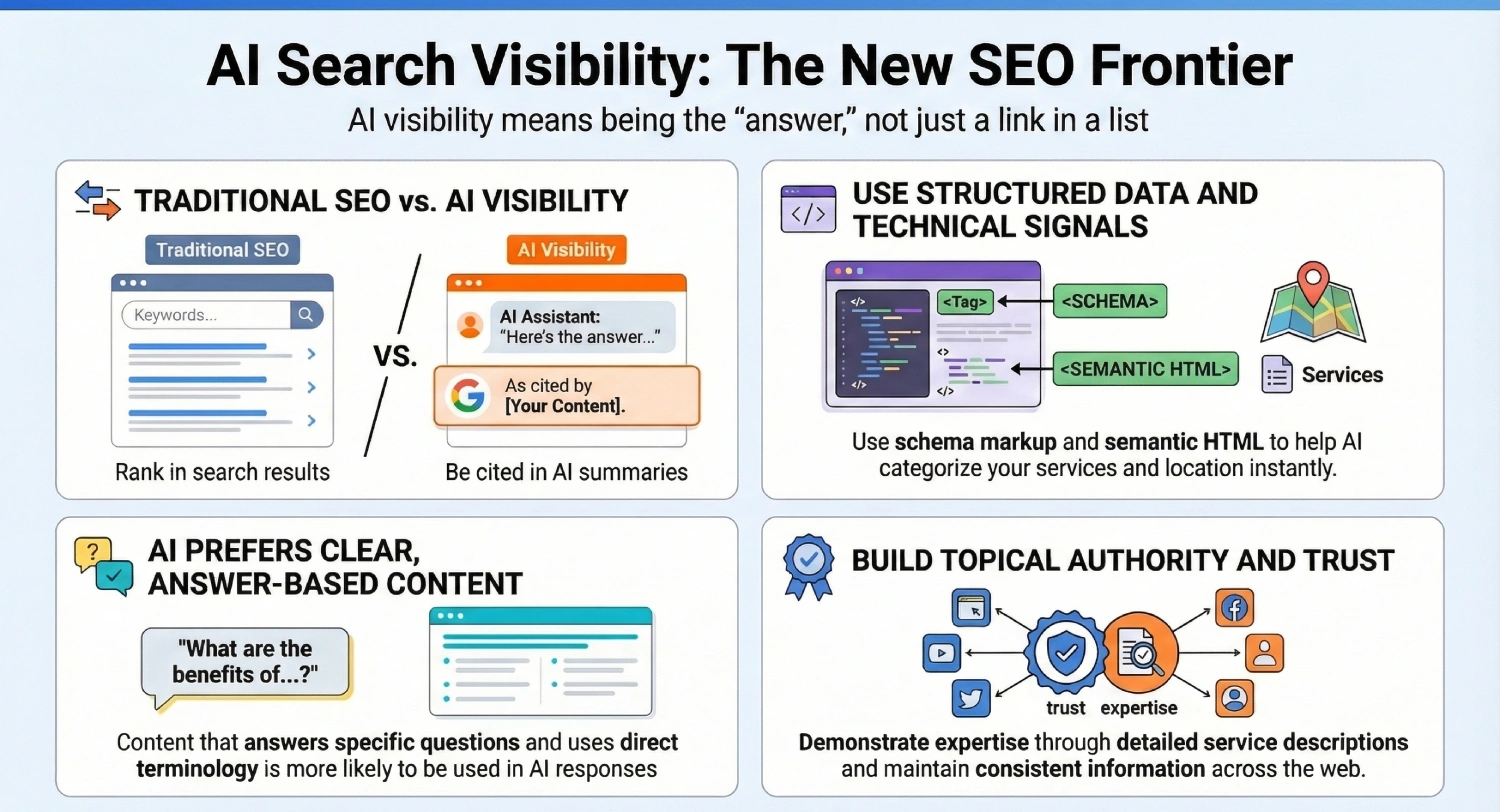
Traditional search engine optimization focuses on improving rankings within search results pages. AI visibility, however, focuses on helping algorithms clearly understand a company’s services, expertise, and information so it can be used when AI systems summarize topics. Businesses that adapt their content to be clear, structured, and authoritative increase their chances of appearing within AI-generated answers.
Why AI Search Visibility Matters
Online search behaviour is evolving quickly as AI tools become part of everyday research. Business owners, procurement professionals, and individual clients are increasingly using conversational AI platforms to explore services, compare companies, and learn about solutions before visiting individual websites. This means the early stages of research are often happening inside AI platforms rather than traditional search results.
When AI systems generate answers, they summarize information from multiple sources and highlight the companies or concepts they consider most relevant. If a business is consistently referenced or reflected within these summaries, it gains visibility and credibility during the research process. Companies that are not recognized or understood by these systems may be overlooked entirely.
As AI-assisted search continues to grow, visibility inside these responses becomes an important part of digital presence. Businesses that structure their content in ways that AI systems can easily interpret position themselves to remain visible as search behaviour evolves and technology continues to influence how people find information.
How AI Systems Find and Use Website Content
AI systems do not operate independently from the internet. Most large language models and AI assistants rely heavily on publicly available web content and search engine indexes to understand topics and generate answers. They analyze information from many websites and identify patterns, definitions, explanations, and expertise related to specific questions.
When AI systems scan websites, they look for content that is clear, structured, and easy to interpret. Pages that explain services, provide detailed information, and present topics logically are easier for algorithms to analyze and summarize. This makes well-organized websites far more likely to contribute to AI-generated answers.
Authority also plays an important role. Websites that demonstrate expertise in a particular subject through detailed content, consistent messaging, and strong informational pages are more likely to be referenced by AI systems. When a website consistently covers related topics, it helps AI tools understand that the business is a reliable source of information within that field.
Website Structure for AI Visibility
A well-organized website structure helps both search engines and AI systems understand the content of a website more effectively. Clear navigation, logical page hierarchy, and dedicated pages for each service or topic make it easier for algorithms to identify what a company does and how its services are categorized.
When information is separated into focused pages, AI systems can extract and summarize specific details more accurately. For example, individual pages describing services, capabilities, or processes allow AI models to clearly identify what the business offers and how those services relate to common search queries.
Internal linking between related pages further strengthens this structure. By connecting service pages, informational resources, and supporting content, websites create a network of information that helps AI systems understand the relationships between topics. This structured approach improves both traditional search visibility and AI-based discovery.
Content That AI Systems Prefer
AI systems work best with content that provides clear explanations and direct information. Websites that answer common questions, explain services in detail, and describe industry processes give AI tools useful material to analyze and summarize. The more clearly a topic is explained, the easier it becomes for algorithms to incorporate that information into answers.
Informational content plays a major role in AI visibility. Sections that describe how services work, what problems they solve, and how companies operate help AI systems understand the broader context of a business. This type of content allows algorithms to identify expertise and determine how a company fits within a particular industry.
Using accurate terminology and industry language also helps AI systems interpret content correctly. When businesses clearly describe their capabilities, processes, and services using the terms clients commonly search for, AI tools can more easily match that information with relevant questions and topics.
Structured Data and Technical Signals
Technical signals help search engines and AI systems interpret website content more accurately. Structured data, also known as schema markup, provides additional context about a business, its services, and the information presented on a webpage. By labelling content clearly, websites help algorithms understand what each section represents.
Structured data can identify elements such as services, organizations, locations, and frequently asked questions. This additional layer of information allows search engines and AI systems to categorize content more effectively and connect it with relevant search queries or topics.
Clear semantic HTML also supports AI visibility. Proper use of headings, lists, and structured page elements helps algorithms read and interpret information more efficiently. When technical structure aligns with clear content organization, websites provide stronger signals that improve discoverability and interpretation by both search engines and AI systems.
Authority and Trust Signals
AI systems prioritize information from sources that appear credible and knowledgeable about a topic. Websites that demonstrate expertise through detailed service descriptions, educational content, and consistent messaging are more likely to be recognized as reliable sources of information.
Trust signals also contribute to how AI systems evaluate content. Clear company information, well-written service pages, and detailed explanations of capabilities help establish legitimacy and professionalism. When businesses communicate their experience and knowledge clearly, algorithms gain confidence in the reliability of the information.
Consistency across the digital presence of a business further strengthens these signals. When a company maintains accurate information across its website, directories, and other online platforms, it reinforces credibility. Over time, this consistency helps AI systems associate the business with its industry and areas of expertise.
AI-Friendly Content Formatting
The way content is formatted influences how easily AI systems can analyze and extract information. Clear headings divide content into understandable sections, helping algorithms identify the main topics discussed on a page. Logical structure improves both readability for users and interpretability for automated systems.
Short paragraphs and organized lists make information easier to process. When complex ideas are broken into structured explanations, AI models can more easily summarize key points or identify relevant sections related to a question.
Definitions, explanations, and descriptive headings also help clarify meaning. When websites clearly label topics and explain concepts step by step, AI systems can recognize and reuse those explanations when generating answers for users searching for similar information.
Visibility Across Multiple Platforms
AI search visibility extends beyond traditional search engines. Many modern AI tools draw information from web indexes, knowledge sources, and publicly available online content. This means a business’s visibility across the broader internet contributes to how often it appears in AI-generated answers.
Search engines still play a major role in this ecosystem. When websites perform well in traditional search results, their content becomes more accessible to AI systems that rely on search engine indexes to retrieve information.
A broader digital presence also supports AI visibility. When businesses appear across trusted websites, industry directories, and informational platforms, they strengthen the signals that AI systems use to understand authority and expertise within a particular field.
Monitoring AI Search Visibility
As AI search continues to evolve, monitoring visibility becomes an important part of digital strategy. Businesses can periodically review how AI tools respond to questions related to their services or industry to understand whether their company is mentioned or reflected in generated answers.
Tracking these responses helps identify gaps in content or areas where additional information may be needed. If AI systems consistently reference certain types of content or explanations, businesses can expand those sections on their websites to strengthen their presence in future responses.
Monitoring also allows companies to adjust their strategy over time. As AI search behaviour changes and platforms update their systems, reviewing visibility across different tools helps businesses refine their content and maintain a strong digital presence.
AI Search Optimization Strategy
Optimizing for AI search visibility requires a structured and ongoing approach. The process often begins with identifying the types of questions users ask about a business’s services, industry, or capabilities. These questions guide the development of informational pages that clearly address common topics.
Building strong topical coverage is another key element. When a website consistently publishes detailed content around related subjects, it strengthens its position as a reliable source of information. This helps both search engines and AI systems understand the depth of expertise associated with the website.
Continuous improvement also plays an important role. As search behaviour evolves and new questions emerge, expanding and refining website content helps maintain visibility. Businesses that regularly update and improve their digital presence remain better positioned to appear in both traditional search results and AI-generated answers.
AI Search Optimization Services
AI search optimization services focus on helping businesses improve how their websites are understood by modern search technologies. This process often begins with a detailed review of website structure, content clarity, and technical elements that influence how information is interpreted by algorithms.
After identifying opportunities, improvements can be made to page structure, service descriptions, and informational content. Strengthening these areas helps ensure that both search engines and AI systems clearly recognize the expertise, capabilities, and services offered by the business.
Long-term optimization may also include expanding topic coverage, improving technical structure, and strengthening authority signals across the digital presence of a company. These efforts help businesses remain visible as search technologies continue to evolve and as AI systems become increasingly integrated into how people research services and solutions.